If you’ve added collagen to your routine, there’s a good chance you’ve wondered whether you’re taking it at the “right” time. Morning, with your coffee? At night, while your body repairs? On an empty stomach, or with food? The internet has an opinion on all of it — and most of them contradict each other.
So let’s cut through the noise. Here’s what actually matters when it comes to timing your collagen intake, what the science says, and how to turn it into a ritual you’ll actually keep.
Does timing really matter?
Here’s the honest answer: the research on collagen and skin focuses overwhelmingly on consistency and dose, not the hour on the clock. Studies that show improvements in skin hydration, elasticity and firmness run for 8 to 12 weeks of daily intake. The common thread isn’t a magic window, it’s that people took it every single day.
In other words, the best time to take collagen is the time you won’t forget. A dose you skip at the “optimal” moment does nothing. A dose you take reliably at a slightly “imperfect” time does the work. Consistency is the whole game.
The case for morning collagen
Mornings have one big thing going for them: they’re hard to skip. You’re already in motion — kettle on, day starting — so a morning dose stacks neatly onto a habit you already have. That’s the first domino. One small choice that sets your whole day in motion.
There’s a formulation argument too. Collagen synthesis depends on co-factors, and vitamin C is the headline act — your body literally can’t build collagen without it. A morning dose that pairs collagen-supporting amino acids with vitamin C gives your skin the building blocks and the tool to use them, right as your day begins.
The case for night
The evening camp points to overnight repair, your body does a lot of its recovery work while you sleep, so the logic goes that collagen support at night meets demand. It’s a reasonable idea, and if bedtime is genuinely your most reliable moment, take it then. But the evidence that nighttime beats morning for skin outcomes is thin. Again: reliability wins over theory.
With food, or without?
You don’t need to stress about this. Collagen-supporting amino acids and vitamin C are absorbed well either way. If taking it with food helps you remember (and keeps things gentle on a sensitive stomach), do that. If a glass on rising suits your flow, that works too. The “rules” here are mostly myth — the only one that counts is: don’t miss it.
A quick word on “collagen” vs collagen support
Not all collagen products are the same. Animal-derived collagen peptides deliver pre-formed collagen fragments. Plant-friendly formulas — like our SkinFuel™ — take a different route: they give your body the amino acid building blocks (think glycine and proline) plus the co-factors it needs (vitamin C, zinc, hyaluronic acid) to support its own natural collagen production. Different mechanism, same goal: firmer, more hydrated, more radiant skin. Want the deeper science? We broke it down in
Amino Acids & Collagen Synthesis in Skin Health.
The verdict
Stop optimising and start showing up. The best time to take collagen is daily, at the moment you’re least likely to skip. For most people, that’s the morning — it’s easy to anchor, it pairs beautifully with vitamin C, and it sets the tone for a day of good choices.
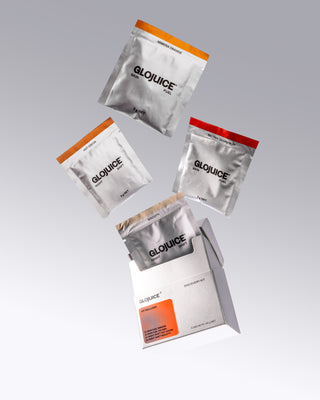
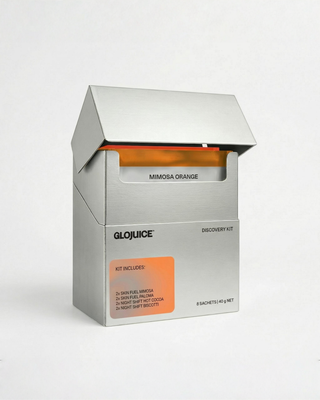
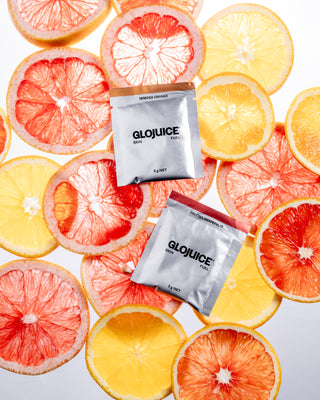
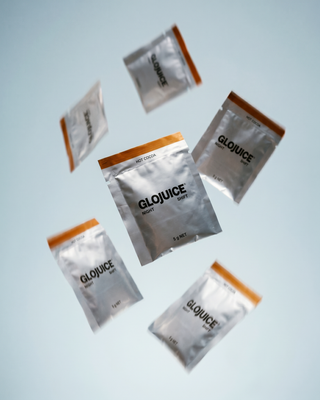
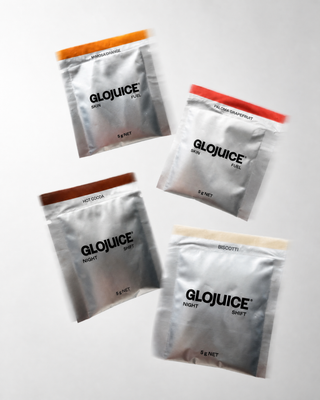
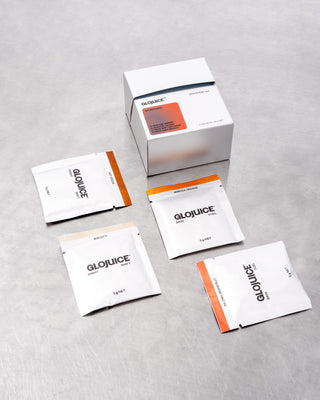
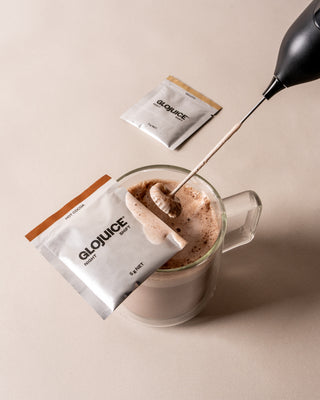
That’s exactly why we built SkinFuel™ for the AM. Vegan collagen support, vitamin C, zinc and hyaluronic acid in one sachet — in Paloma Grapefruit or Mimosa Orange, so it tastes like a treat, not a task. Make it your first domino, and let the glow take care of itself.
Make mornings your glow time - Shop SkinFuel™.
Sources
de Miranda RB, et al.
Effects of hydrolyzed collagen supplementation on skin aging: a systematic review and meta-analysis.
International Journal of Dermatology. 2021;60(12):1449–1461.
https://doi.org/10.1111/ijd.15518
Choi FD, et al.
Oral Collagen Supplementation: A Systematic Review of Dermatological Applications.
Journal of Drugs in Dermatology. 2019;18(1):9–16.
Pullar JM, Carr AC, Vissers MCM.
The Roles of Vitamin C in Skin Health.
Nutrients. 2017;9(8):866. https://doi.org/10.3390/nu9080866
Proksch E, Segger D, Degwert J, Schunck M, Zague V, Oesser S.
Oral supplementation of specific collagen peptides has beneficial effects on human skin physiology: a double-blind, placebo-controlled study.
Skin Pharmacology and Physiology. 2014;27(1):47–55.
Bolke L, Schlippe G, Gerß J, Voss W.
A Collagen Supplement Improves Skin Hydration, Elasticity, Roughness, and Density: Results of a Randomized, Placebo-Controlled, Blind Study.
Nutrients. 2019;11(10):2494.